

Vision
To be a Leading Educational Institution, recognized for Excellence in Diploma Engineering, producing globally competent and socially responsible professionals.
Mission
IM1:
To provide state – of- art infrastructural facilities that support achieving Academic Excellence.
IM2: To provide a work environment that is conducive for professional growth of faculty and staff.
IM3: To collaborate with industry for achieving excellence in Training and Placement.
Program Outcomes (PO’s)
- Design Principles and Concepts: Graduates will demonstrate a thorough understanding of fundamental design principles, theories, concepts, and methodologies relevant to Electrical & Electronics Engineering, encompassing aesthetics, functionality, sustainability, and user-centric design..
- Spatial Planning and Visualization: Graduates will exhibit proficiency in spatial planning, conceptualization, visualization, and representation techniques, utilizing various tools, software, technologies, and mediums to develop, communicate, and present design concepts, ideas, and solutions effectively.
- Material Knowledge and Application: Diploma Students will exhibit competence in designing, planning, and implementing Architecture Engineering, and processes to meet specific requirements, specifications, and performance criteria while considering societal, environmental, and ethical considerations.
- Technical Skills and Documentation: Graduates will demonstrate proficiency in producing comprehensive technical drawings, specifications, documentation, and construction documents, adhering to industry standards, codes, regulations, and best practices, facilitating effective communication, collaboration, and implementation of design solutions.
- Cultural, Historical, and Contextual Understanding: Graduates will exhibit an appreciation for cultural diversity, historical context, societal influences, environmental factors, and global perspectives in interior design and decoration, demonstrating the ability to integrate contextual insights, cultural sensitivity, and informed decision-making into design practice.
- Collaboration and Interdisciplinary Integration: Graduates will effectively collaborate, communicate, and work in interdisciplinary teams, engaging with clients, stakeholders, professionals, and communities to address diverse needs, preferences, goals, and challenges, fostering creativity, innovation, and collaboration in design projects and contexts.
- Ethical and Professional Responsibility: Diploma Students will exhibit ethical behavior, integrity, responsibility, and professionalism in their engineering practice, decision-making processes, interactions, and contributions to society, recognizing the broader impacts and implications of their work.
- Business Acumen and Entrepreneurship: Diploma Graduates will possess foundational knowledge, skills, and competencies in business management, entrepreneurship, marketing, client relations, project management, and professional practice, enabling them to navigate the business aspects, opportunities, challenges, and dynamics of the interior design and decoration industry.
- Lifelong Learning and Professional Development: Graduates will engage in continuous learning, professional development, research, innovation, and adaptability, staying abreast of emerging trends, technologies, materials, methods, and best practices in interior design and decoration, fostering growth, advancement, and excellence in their professional journey.
- Communication and Presentation Skills: Graduates will effectively communicate, articulate, and present design concepts, ideas, solutions, recommendations, and narratives to diverse audiences using various mediums, platforms, technologies, and formats, demonstrating clarity, coherence, creativity, and professionalism in verbal, written, visual, and digital communication.
- These Program Outcomes (POs) provide a comprehensive framework for evaluating, assessing, and enhancing the effectiveness, relevance, quality, and impact of the EEE program, ensuring that graduates are well-prepared, competent, innovative, and ethical professionals capable of contributing to the advancement, transformation, and enrichment of the interior design and decoration industry, profession, and practice.
- Program specific Outcomes (PSO’s)
PSO1 Understand the application of Electrical & Electronics Engineering principles in Electrical & Electronics products and services industries. PSO2 Apply the knowledge of techniques, skills and software applications to design, implement and support Electrical & Electronics Engineering.
Program Details
Eligibility
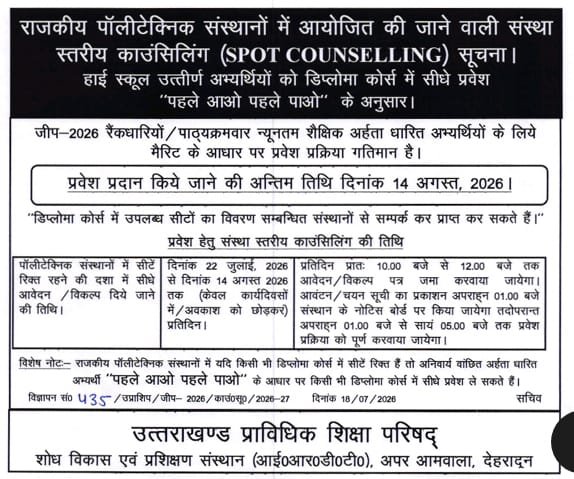
Passed High School Examination with Science and Mathematics (General Mathematics is not acceptable) from Uttarakhand Board of School Education or any equivalent recognized board
Ecology & Environment
As per directives of Government of India, an awareness camp on Ecology and Environment has been incorporated during second semester.
Entrepreneurship Development
An Entrepreneurial Awareness Camp and a full subject on Entrepreneurship Development and Management has been incorporated in the Study Scheme.
Generic Skill Development
It is proposed that two Camps of 3-4 days duration on generic Skills Development(GSD) during 5th and 6th Semester be organized by arranging expert lectures/ discussion sessions either by Polytechnic teacher ot by eminent educationists from the neighborhood to deal eith topics like: Independent Study Techniques, Task Management, Ethics and Values, Personality Development, SWOT Analysis, Action research etc.
Industrial Exposure
The Student will be exposed to industial by orgnanizing industrial visits and expert lectures by personnel from industry. The suggested industry oriented-practice based minor and major projects will enable the students to interact with relecant industries.
Discipline
20 marks per semester have been kept for maintaining discipline which include punctuality, attendance behaviour etc.